
LIVE NEWS
  • After 200 years scientists finally crack the “dolomite problem”
  • Japan issues an advisory for northern coastal areas for a slightly increased risk of a mega-quake
  • Spot Bitcoin ETFs Near $1 Billion in Weekly Inflows, Best Stretch Since Mid-January
  • NCSC Outlines Coordinated Plan to Boost NHS Cyber Resilience
  • Top Golang Backend Frameworks for Developers in 2026
  • Decades of increased emissions from forest-fuelled BECCS
  • Virginia redistricting campaigns have left voters confused : NPR
  • It doesn’t matter how much you sit — walking more could lower your risk of death and disease
Prime Reports
  • Home
  • Popular Now
  • Crypto
  • Cybersecurity
  • Economy
  • Geopolitics
  • Global Markets
  • Politics
  • See More
    • Artificial Intelligence
    • Climate Risks
    • Defense
    • Healthcare Innovation
    • Science
    • Technology
    • World
Prime Reports
  • Home
  • Popular Now
  • Crypto
  • Cybersecurity
  • Economy
  • Geopolitics
  • Global Markets
  • Politics
  • Artificial Intelligence
  • Climate Risks
  • Defense
  • Healthcare Innovation
  • Science
  • Technology
  • World
Home»Science»‘How can all of this be happening?’: Scientists spot massive group of ancient galaxies so hot they shouldn’t exist
Science

‘How can all of this be happening?’: Scientists spot massive group of ancient galaxies so hot they shouldn’t exist

primereportsBy primereportsJanuary 7, 2026No Comments3 Mins Read
Share Facebook Twitter Pinterest LinkedIn Tumblr Reddit Telegram Email
‘How can all of this be happening?’: Scientists spot massive group of ancient galaxies so hot they shouldn’t exist
Share
Facebook Twitter LinkedIn Pinterest Email


Astronomers have spotted an unexpectedly hot galaxy cluster in the early universe that’s challenging theories of galactic evolution.

The scorching cluster existed just 1.4 billion years after the Big Bang, blazing far earlier and hotter than current models of galaxy cluster formation predict should be possible. The discovery suggests that the predicted patterns of cluster growth might need a rethink, researchers reported Jan. 5 in the journal Nature.

Galaxy clusters are collections of dark matter and hundreds to thousands of galaxies, all bound together by gravity. Those galaxies are separated by a mix of gas known as the intracluster medium. As galaxy clusters form, the intracluster medium heats up due to gravitational interactions within the cluster and energy emissions from young stars and black holes. But this process takes a long time, and scientists have only rarely observed a hot intracluster medium in young galaxy clusters.


You may like

“Understanding galaxy clusters is the key to understanding the biggest galaxies in the universe,” study co-author Scott Chapman, an astrophysicist at Dalhousie University who conducted the research while at the National Research Council of Canada (NRC), said in a statement. “These massive galaxies mostly reside in clusters, and their evolution is heavily shaped by the very strong environment of the clusters as they form, including the intracluster medium.”

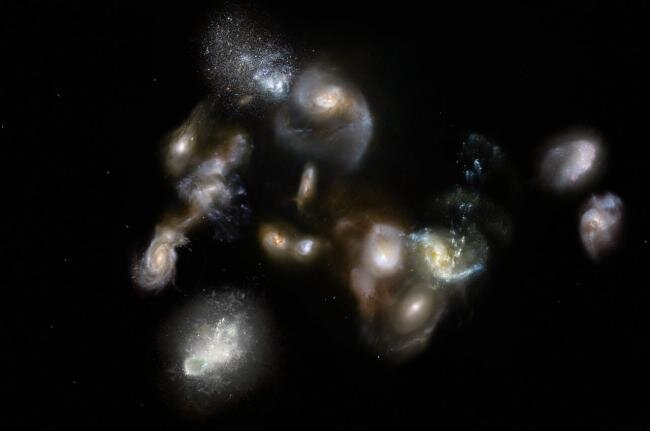
In the new study, researchers used the Atacama Large Millimeter/submillimeter Array (ALMA), a powerful radio telescope located in Chile, to observe a bright, young galaxy cluster known as SPT2349-56, whose light was emitted just 1.4 billion years after the Big Bang. This cluster is relatively small — about the size of the Milky Way‘s outer halo — but it contains more than 30 active galaxies and three supermassive black holes, and it forms stars more than 5,000 times as fast as the Milky Way.

Using a phenomenon called the thermal Sunyaev-Zeldovich effect, the team found that the gas in the intracluster medium is at least five times hotter than current theories of cluster formation predict it should be for its relatively young age.

Spinning, glowing orbs of white, yellow and blue are placed seemingly randomly but nearby against a pitch black background.

An artist’s impression of the galaxy cluster SPT2349-56. (Image credit: ESO/M. Kornmesser)

“We didn’t expect to see such a hot cluster atmosphere so early in cosmic history,” study coauthor Dazhi Zhou, a PhD student in the department of physics and astronomy at the University of British Columbia, said in the statement. “In fact, at first I was skeptical about the signal as it was too strong to be real.”

Get the world’s most fascinating discoveries delivered straight to your inbox.

But it was real — and that could mean that galaxy clusters can form more quickly than expected.

“This tells us that something in the early universe, likely three recently discovered supermassive black holes in the cluster, were already pumping huge amounts of energy into the surroundings and shaping the young cluster, much earlier and more strongly than we thought,” Chapman said.

In future studies, the team plans to investigate what this unusual cluster might mean for the formation and evolution of existing galaxy clusters.

“We want to figure out how the intense star formation, the active black holes and this overheated atmosphere interact, and what it tells us about how present galaxy clusters were built,” Zhou said. “How can all of this be happening at once in such a young, compact system?”

Share. Facebook Twitter Pinterest LinkedIn Tumblr Email
Previous ArticleMoto Watch can go nearly two weeks and brings Polar’s pro-tier fitness perks 
Next Article DOD launches review of ‘effectiveness’ of women in ground combat roles
primereports
  • Website

Related Posts

Science

After 200 years scientists finally crack the “dolomite problem”

April 20, 2026
Science

Watch SpaceX launch advanced GPS satellite for US Space Force early on April 20

April 19, 2026
Science

Canadian astronaut’s bon mots help heal wounds from French language row | Canada

April 19, 2026
Add A Comment
Leave A Reply Cancel Reply

Top Posts

Global Resources Outlook 2024 | UNEP

December 6, 20258 Views

The D Brief: DHS shutdown likely; US troops leave al-Tanf; CNO’s plea to industry; Crowded robot-boat market; And a bit more.

February 14, 20264 Views

German Chancellor Merz faces difficult mission to Israel – DW – 12/06/2025

December 6, 20254 Views
Stay In Touch
  • Facebook
  • YouTube
  • TikTok
  • WhatsApp
  • Twitter
  • Instagram
Latest Reviews

Subscribe to Updates

Get the latest tech news from FooBar about tech, design and biz.

PrimeReports.org
Independent global news, analysis & insights.

PrimeReports.org brings you in-depth coverage of geopolitics, markets, technology and risk – with context that helps you understand what really matters.

Editorially independent · Opinions are those of the authors and not investment advice.
Facebook X (Twitter) LinkedIn YouTube
Key Sections
  • World
  • Geopolitics
  • Popular Now
  • Artificial Intelligence
  • Cybersecurity
  • Crypto
All Categories
  • Artificial Intelligence
  • Climate Risks
  • Crypto
  • Cybersecurity
  • Defense
  • Economy
  • Geopolitics
  • Global Markets
  • Healthcare Innovation
  • Politics
  • Popular Now
  • Science
  • Technology
  • World
  • About Us
  • Contact Us
  • Privacy Policy
  • Terms & Conditions
  • Disclaimer
  • Cookie Policy
  • DMCA / Copyright Notice
  • Editorial Policy

Sign up for Prime Reports Briefing – essential stories and analysis in your inbox.

By subscribing you agree to our Privacy Policy. You can opt out anytime.
Latest Stories
  • After 200 years scientists finally crack the “dolomite problem”
  • Japan issues an advisory for northern coastal areas for a slightly increased risk of a mega-quake
  • Spot Bitcoin ETFs Near $1 Billion in Weekly Inflows, Best Stretch Since Mid-January
© 2026 PrimeReports.org. All rights reserved.
Privacy Terms Contact

Type above and press Enter to search. Press Esc to cancel.