

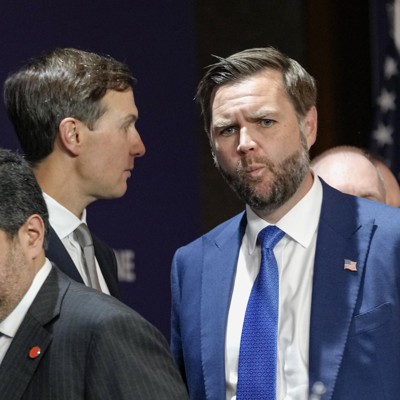
A new U.S.-Iran peace plan can work only if the United States can overcome three difficult challenges, experts said: the Iranians must agree to tighter international inspections, the inspecting agency must fix its budget crisis, and the White House must heed nuclear experts over real-estate developers with ties to President Trump.
As U.S. and Iranian diplomats met in Switzerland on Monday, they seemed unable to agree even about whether they disagreed on inspections. U.S. Vice President JD Vance triumphantly proclaimed that the Iranians had agreed to allow the return of International Atomic Energy Agency inspectors back to monitor nuclear materials and research activity. Iranian officials said they’d done no such thing. Should the Iranians agree, experts said, the IAEA will have enough technical expertise to make inspections work again, but only if U.S. nuclear security professionals are involved, experts said.
That’s because the job would be harder than it was in 2015, when Tehran accepted broader international monitoring and sharp limits on nuclear development under the JCPOA deal forged by the Obama administration and several international partners. After the Trump administration withdrew from the deal in 2021, Iran began restricting inspectors’ access to data and facilities.
Inspectors would begin without a clear understanding of how much nuclear material Iran holds or how many centrifuges and other enrichment tools it has.
“There is a real risk that Iran has diverted centrifuges to an undeclared location, and that the IAEA does not know where those machines are,” Kelsey Davenport, the director for nonproliferation policy at the Arms Control Association, told reporters on Friday. “If we look at Iran’s production capabilities, they were capable of producing more centrifuges than were installed at Natanz and Fordow”—two heavily fortified Iranian enrichment sites that the U.S. bombed last June. “One of the key tasks for the IAEA will be to work with Iran to try to kind of track them down.”
The agency will find it difficult to “provide any confidence that Iran does not retain an undeclared enrichment capability somewhere outside of the facilities attacked last summer, which would be a huge problem,” Matthew Sharp, a senior nuclear fellow at MIT’s Center for Nuclear Security Policy, said in an email. “If there are discrepancies between what material Iran makes available now and what the IAEA last observed more than a year ago (e.g., if some of the material is buried or otherwise unavailable), that will be more difficult to make sense of.”
The IAEA does have an “Additional Protocol” that allows the agency to hunt for material and devices that may have been “destroyed in the strikes or have been hidden away by Tehran,” said Eric Brewer, the deputy vice president for NTI’s Nuclear Materials Security Program.
But, he said, the Additional Protocol must be in the final agreement for inspections to really work.
The experts said today’s inspectors can draw upon advancements in satellite imagery, open-source intelligence, and even AI, but that there remains no substitute for on-site inspections.
Underfunded IAEA
Another obstacle is the financial health of the agency. Earlier this month, IAEA Director General Rafael Mariano Grossi told the agency’s board of directors that it is missing €250 million in “overdue assessed contribution amounts.” He also warned that if dues aren’t paid by mid-August, the agency won’t be able to make payroll or fund key operations.
MIT’s Sharp called that scenario a “self-made catastrophe” for the United States.
The agency has largely escaped the sort of condemnation and threats that Trump directs at other international institutions, such as its parent organization, the United Nations. Sharp called that good news. “President Trump did not include the IAEA in the 66 multilateral organizations from which he withdrew last year, and IAEA Director General Grossi has apparently been engaged in the U.S.-Iran talks, which is a positive sign of confidence in the IAEA and understanding.”
But “understanding” isn’t the same as full support. As recently as March, the State Department was pressuring the IAEA to re-examine compensation for inspectors and other staff and rein in expenses.
“Grossi didn’t name names, but it seems very likely to me that the United States is a primary driver of the shortfall and therefore to blame,” said Sharp.
Either way, said Sharp, the White House should stop congratulating itself.
“Any idea that Iran ‘inviting’ the IAEA to come back to its facilities is somehow a victory to be compensated is farcical. Iran has for more than fifty years had a legal obligation to allow inspections in ALL of its nuclear facilities under its safeguards agreement with the IAEA.”
A bigger question, at least for the ACA’s Davenport, is whether the White House will actually listen to U.S. and IAEA experts if their advice or findings inconvenience Trump and his allies, such as envoys Steve Witkoff and Jared Kushner, who had been playing a role in the negotiations while simultaneously working a series of personal side-deals.
Davenport said that “Kushner and Witkoff need to center nuclear experts and listen to nuclear experts because their technical incompetence caused the United States to miss critical diplomatic opportunities in the past.”
