

UN Photo/Laura Jarriel
SRINIGAR, India & PARIS, June 23 (IPS) – As the world enters the final years before the 2030 deadline for achieving the Sustainable Development Goals (SDGs), a latest United Nations report has revealed that economic uncertainty, climate change, conflict and growing geopolitical tensions are causing hurdles for the countries to meet the targets.
The Sustainable Development Report 2026, released by the UN Sustainable Development Solutions Network (SDSN), finds that fewer than one in five SDG targets are currently on track worldwide.
The authors note that the vast majority of UN Member States remain committed to the framework, but a small number of countries, most notably the United States, have moved into active opposition to the paradigm of sustainable development and the multilateral
institutions that underpin it.
Professor Jeffrey D. Sachs, President of the SDSN and a lead author of the report, noted the successes but said conflict was severely impacting the achievement of the goals.
“Support for sustainable development as the global paradigm remains strong throughout the world. Notable success stories have emerged across East and South Asia and in many other countries and regions. Sustainable development cannot be achieved amid ongoing conflict, making peace the top priority of our time,” said Sachs. “As the 2030 landmark approaches, the next era of sustainable development must put the global emphasis on implementation and ensuring strong financing and effective governance at all levels.”
The report highlights encouraging developments, particularly in Asia, where countries such as India and China have made some of the fastest gains since the goals were adopted in 2015.
The report arrives at a critical moment when governments are beginning discussions about what should follow the SDGs after 2030, while many countries continue to grapple with economic uncertainty, climate change, conflict and growing geopolitical tensions.
“Commitment to the SDGs remains strong globally,” the report states, noting that a large majority of countries continue to support sustainable development resolutions at the United Nations.
The SDGs were adopted by all 193 UN member states in 2015 as a universal blueprint to end poverty, protect the planet and ensure prosperity for all. The goals cover a broad range of issues, including hunger, health, education, gender equality, climate action, peace and justice.
Eleven years later, the new report concludes that progress has been uneven.
Globally, only 16.5 percent of SDG targets are on track to be achieved by 2030. The strongest progress has been recorded in areas such as internet access, mobile broadband subscriptions, electricity access, reductions in adolescent fertility rates and new HIV infections.
At the same time, some of the world’s biggest challenges remain stubbornly unresolved.
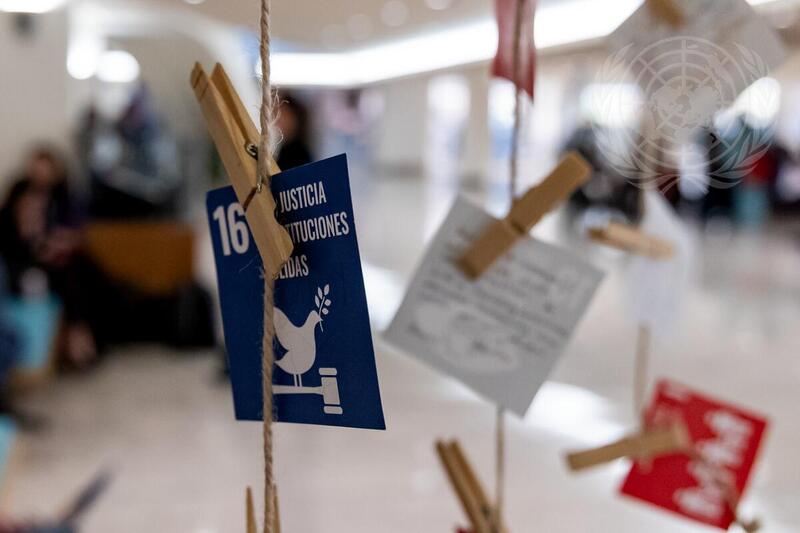
Targets related to hunger, sustainable agriculture, corruption, press freedom and effective justice systems are among those furthest from achievement. The report has identified SDG 2, Zero Hunger, and SDG 16, Peace, Justice and Strong Institutions, as areas facing some of the most serious setbacks.
Countries affected by war, political instability and weak public finances continue to lag behind.
Finland retained its position as the world’s top performer on the SDG Index, followed by Sweden and Denmark. However, even these leading countries face significant challenges in areas such as responsible consumption, climate action and biodiversity protection.
At the other end of the rankings are countries struggling with conflict and insecurity, including Chad, the Central African Republic and South Sudan.
One of the report’s strongest findings is the growing role of East and South Asia in advancing sustainable development.
According to the study, East and South Asia have outperformed every other region in SDG progress since 2015. Emerging economies that started with lower development baselines have generally moved faster than many wealthier countries.
The report notes that India and Ethiopia recorded the largest gains among major countries, improving their SDG scores by 9.6 and 9.7 percentage points, respectively, since 2015. The Philippines and Vietnam also posted strong gains.
The report says India has climbed 18 places in the SDG rankings since 2015, representing one of the largest improvements among major economies. China improved by 14 places during the same period.
“Countries in East and South Asia have achieved greater SDG progress than those in any other region since 2015,” the report says.
Researchers attribute much of this progress to improvements in socio-economic indicators, including access to services, infrastructure and financial inclusion, though environmental goals remain a challenge across many countries.
India’s country profile in the report shows progress in internet use, digital services, rural road connectivity and access to online government services. However, challenges remain in areas such as air pollution, urban living conditions and research investment.
While support for sustainable development remains widespread, the report has raised concerns about growing strains on international cooperation.
A new Index of Countries’ Support for UN Based Multilateralism ranks Barbados first among 193 UN member states, while the United States ranks last.
Barbados, Antigua and Barbuda, Uruguay, Trinidad and Tobago, the Maldives and several other developing countries occupy the top positions in the ranking.
Furthermore, the report has described the United States as a “statistical outlier” with weak performance across all six indicators used to measure support for multilateral cooperation. It notes that Washington opposed SDG-related resolutions and withdrew from more than 60 international organizations in early 2026.
“There has been a sharp drop across all world regions in the share of member states’ UNGA votes that align with the United States,” the report says. It adds that the United States voted with the international majority in only five percent of recorded UN General Assembly votes in 2025.
India is classified among countries showing moderate support for UN based multilateralism, alongside Canada, Italy, South Korea and Egypt.
The report warns further that growing military spending and increasing participation in conflicts are weakening support for multilateral cooperation in many parts of the world.
Commenting on multilateralism, Dr Guillaume Lafortune, Vice President of the SDSN and a lead author and coordinator of the report said that geopolitical headwinds were testing the resilience of the multilateral system
“The moment calls for all countries to reaffirm the principles of the UN Charter, starting with Article 1, and to cooperate in building acredible global and regional security architecture. The next era of sustainable development must prioritise implementation through a reformed Global Financial Architecture, greater involvement of continental, regional, and local institutions, but also a central role for civil society and universities in driving accountability, innovation, and solutions on the ground.”
Beyond the rankings and statistics, the report includes surveys of experts and more than 1,000 respondents from 127 countries about barriers to achieving the SDGs.
Among the most frequently cited obstacles were lack of political will, poor execution of approved policies, governance failures, corruption, weak public participation and inadequate financing.
Survey participants also highlighted climate change, weak monitoring systems and fragmented institutional coordination as major barriers.
According to the report, 89 percent of respondents identified failure to implement approved strategies as a major obstacle, while 87 percent pointed to geopolitical tensions as a significant barrier to progress.
Respondents from East Asia and South Asia generally expressed more positive views about progress in their countries compared with respondents from North America and Latin America.
The report has argued that the next phase of global development efforts must focus less on creating new goals and more on ensuring implementation.
Researchers have outlined eight priorities for the years ahead, including ending wars, redirecting military spending toward human development, adopting long-term investment plans, strengthening regional cooperation, creating new global financing mechanisms and establishing governance frameworks for emerging technologies such as artificial intelligence and biotechnology.
The report also proposes new UN campuses in Asia, Africa and Latin America and calls for stronger systems of accountability, open data and participatory decision-making.
“Strengthening implementation is the key priority for the post-2030 agenda,” the report reads.
With less than four years remaining before the SDG deadline, the report has stated that the future of sustainable development will depend not on new promises but on the ability of governments and institutions to deliver on the promises already made.
IPS UN Bureau Report
© Inter Press Service (20260623065023) — All Rights Reserved. Original source: Inter Press Service
