

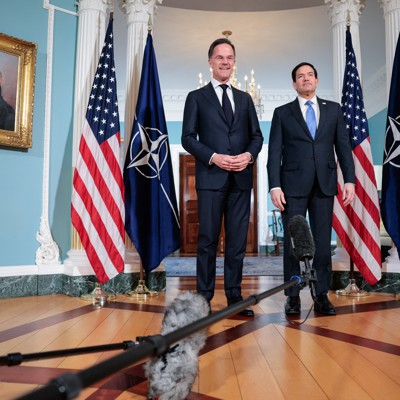
The Atlantic alliance can no longer be managed through reassurance, communiqués, or the fiction that its internal tensions are political noise. They are structural. Mark Rutte’s recent visit to Washington made that clear. NATO requires rebalancing: a more credible distribution of responsibility, capability, and strategic weight across the alliance.
Beneath this lies a growing crisis of trust. Europeans no longer simply ask whether the United States will stay engaged; they worry that ambiguity or sudden shifts in Washington could hollow out deterrence and tempt adversaries to test what was once an ironclad commitment. Unequal burden‑sharing has shifted from a long‑running grievance to a hard instrument of leverage. The American message to Europe is blunt: step up or live with more conditional U.S. guarantees. Europeans, for their part, argue they are already carrying heavier financial and political costs. They also demand a seat at the table: they expect to be consulted, not simply informed, when decisions with direct consequences for European security are made.
The alliance cannot afford to remain trapped in this cycle of mutual recrimination—it must move decisively to embrace rebalancing as a strategic imperative that serves the long-term interests of both sides of the Atlantic.
The simultaneous wars in Ukraine and the Middle East have revealed just how critical transatlantic rebalancing is. Russia’s war against Ukraine has been the alliance’s most clarifying test in decades. Without Washington’s intelligence, industrial capacity, and political resolve, Ukraine’s resistance would have looked very different. That European dependency is a structural condition, built over thirty years of unbalanced burden-sharing, that now constitutes a strategic liability for the Alliance as a whole. In the Strait of Hormuz, the calculus ran in the other way: the United States recognized that it needed European military bases, naval presence, and diplomatic cover to manage escalation in a region where allies are deeply exposed. Taken together, these two theaters make the case that neither side can afford to act alone.
This is an inflection point—one that requires the terms of the transatlantic relationship to be reset and clarified. Against this backdrop, GMF’s new Europe Defense Roadmap lays out three structural reforms that allies urgently need to operationalize.
First, Europe must transform defense spending into integrated strategic capability. The structural shift from a U.S.-led security order in Europe to a European-led framework—supported but no longer directed by the United States—is no longer hypothetical. It is accelerating. Spending announcements are not capabilities. The historic shifts in German defense investment, Poland’s military buildup, and Nordic-Baltic rearmament are real and significant—but fragmented national procurement will not produce the interoperable architecture a rebalanced Alliance requires. The issue is no longer whether Europe spends more. It is whether Europe can pool procurement, expand industrial depth, and generate interoperable force at the scale required on NATO’s eastern flank. Without that, burden-shifting will remain a slogan.
Second, NATO must replace its outdated burden-sharing metrics with a framework that actually measures strategic value. The 2 percent, and now 5 percent, benchmark is a political signal, but it is not, by itself, a serious measure of alliance contribution. Both NATO and the EU already use more granular mechanisms to track defense efforts, covering force readiness, deployable units, intelligence sharing, logistical capacity and resilience to hybrid threats. Taken seriously, these tools offer a more accurate picture of who delivers what to collective defense than headline spending alone. They would also recast the transatlantic argument: from an annual quarrel over percentages to a more rigorous and measurable assessment of strategic partnership.
Third, the Alliance must settle the European strategic autonomy debate—permanently—and embrace strategic complementarity instead. The decade-long argument that European defense capacity somehow threatens Alliance unity has served no one. The choice is not between a Europe that duplicates American power and a Europe that remains permanently dependent on it. The choice is between a Europe that can act and fill operational gaps when the U.S. is stretched across theatres and one that cannot. Ukraine and Iran, taken together, make the case. Rutte effectively hinted at this shift in Washington when he argued that Europe must move from “unhealthy co-dependence” to “true partnership”. That is the right formula. A stronger European pillar does not weaken deterrence and defense. It makes it more credible.
The transatlantic relationship will be preserved and strengthened only by being transformed. The task is to build a version of the alliance suited for the strategic conditions of the next decade: one in which American commitment is sustained by European capability, and European ambition is anchored in a strategic contribution framework that reframes the conversation in terms Washington can act on and Brussels can deliver: not just how much Europe spends, but what Europe can do—reliably and at scale, within EU, NATO and/or coalition frameworks. Europe will need clear planning, coordinated investments, and a shared pathway for collective defense and crisis management. That is the real message: Stop managing NATO. Start rebalancing it.
