
LIVE NEWS
  • AI costs how much? GitHub Copilot users react to new usage-based pricing system.
  • European Parliament committee votes to scrap US tariffs
  • Hints and Solutions for June 2
  • It has the highest levels of toxic Pfas in drinking water in Scotland. But how did this remote island become awash with forever chemicals? | Pfas
  • For veterans, a place where peace can take root : NPR
  • This common amino acid helped mice survive deadly inflammation
  • Apple Will Reportedly Add Bill-Splitting Feature to iOS 27
  • Opinion | Putin Has No Good Way Out of His War
Prime Reports
  • Home
  • Popular Now
  • Crypto
  • Cybersecurity
  • Economy
  • Geopolitics
  • Global Markets
  • Politics
  • See More
    • Artificial Intelligence
    • Climate Risks
    • Defense
    • Healthcare Innovation
    • Science
    • Technology
    • World
Prime Reports
  • Home
  • Popular Now
  • Crypto
  • Cybersecurity
  • Economy
  • Geopolitics
  • Global Markets
  • Politics
  • Artificial Intelligence
  • Climate Risks
  • Defense
  • Healthcare Innovation
  • Science
  • Technology
  • World
Home»Science»What is quantum gravity? Scientists think it could explain the beginning of our universe
Science

What is quantum gravity? Scientists think it could explain the beginning of our universe

primereportsBy primereportsApril 29, 2026No Comments4 Mins Read
Share Facebook Twitter Pinterest LinkedIn Tumblr Reddit Telegram Email
What is quantum gravity? Scientists think it could explain the beginning of our universe
Share
Facebook Twitter LinkedIn Pinterest Email


Scientists have redefined gravity to explain the Big Bang and perhaps change our picture of the earliest moments of the cosmos. This new framework of “quantum gravity” may explain aspects of the Big Bang that Albert Einstein’s 1915 theory of gravity, general relativity, fails to account for — maybe even doing away with the challenging concept of a singularity existing prior to the dawn of the universe.

Proving the concept of quantum gravity is something of a holy grail for physicists, as it would bridge the gap between the explanation we have of the universe on vast cosmic scales (general relativity) and on tiny scales (quantum physics).

However, general relativity doesn’t just fail at small scales; the theory also collapses when trying to explain the extreme high-energy conditions that existed during the universe’s first moments. To get around this issue, a team of researchers, led by Niayesh Afshordi, a professor of physics and astronomy at the University of Waterloo and Perimeter Institute, explored a theory called Quadratic Quantum Gravity. As it turns out, this theory seems to work even when explaining the high-density, high-temperature birth of the cosmos.


You may like

“General relativity works extraordinarily well in many settings, but when we run it back to the Big Bang, and apply it to the inside of black holes, it predicts a singularity: a moment where density, curvature and temperature formally become infinite. That is usually a sign that the theory is being pushed beyond where it can be trusted,” Afshordi told Space.com. “In other words, general relativity is likely incomplete for describing the very first moments of the universe, when quantum effects should also matter.”

Expanding the standard picture of general relativity

Afshordi explained that in the standard picture of the Big Bang, scientists usually start with Einstein’s theory of gravity, then add extra ingredients to explain the earliest moments of the universe, most notably a hypothetical “inflation field” to account for the initial rapid expansion of the cosmos.”

Our approach asks whether some of that early-universe behavior could come directly from gravity itself, once gravity is extended in a way that remains better behaved at extremely high energies,” he said. “So, instead of treating the Big Bang as a point where our equations fail and then patching over that with additional assumptions, we study a theory in which gravity already contains the ingredients needed to describe that ultra-early phase more consistently. This is what physicists call an ultraviolet completion: a theory that remains complete and self-consistent even at arbitrarily high energies.”

The team’s quantum-consistent extension of gravity recovers a model of early cosmic inflation, while also potentially removing the troubling concept of an initial singularity.

What is quantum gravity? Scientists think it could explain the beginning of our universe

“Our model provides a very good fit to current data, in some cases better than many standard inflationary models,” Afshordi said. “What surprised me most was how naturally an inflation-like phase emerged once the theory was treated in a consistent high-energy, or ultraviolet complete, framework. We often think of inflation as something that must be added on top of gravity, so it is striking that it may instead arise from gravity itself. More broadly, it was encouraging to see that a relatively minimal extension of Einstein’s theory could already go a long way toward resolving the deep problem of our cosmic origins.”
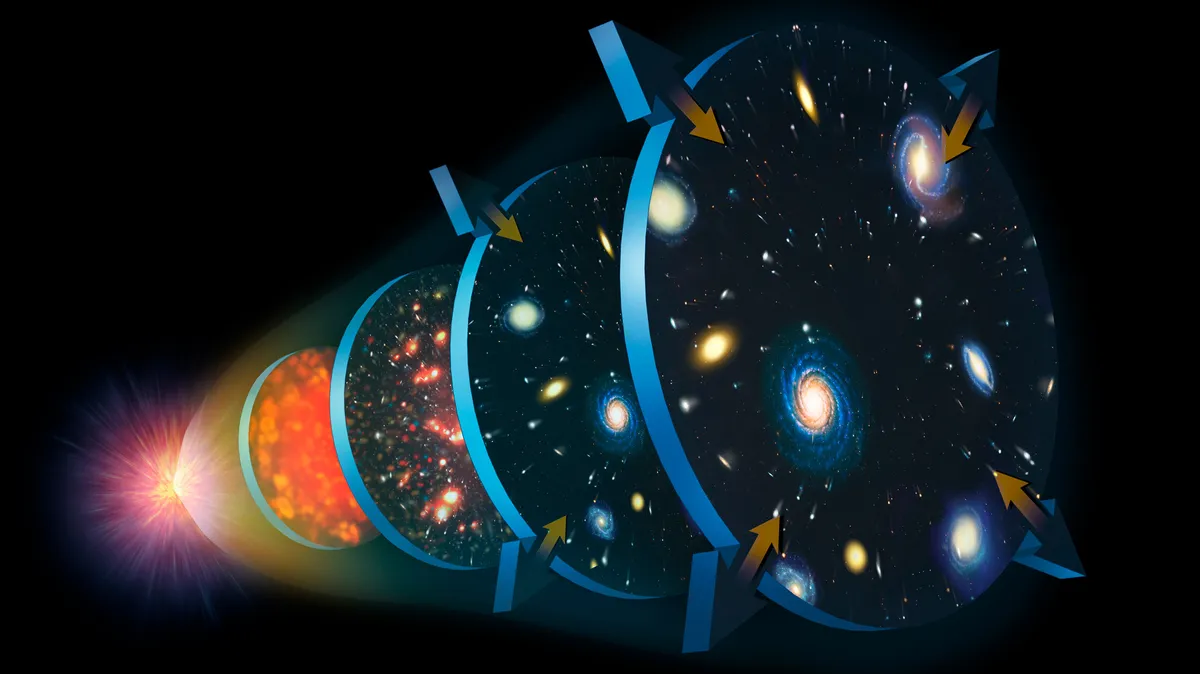
big bang theory illustrated in different circles showing the progression of galaxy growth throughout the universe.

An illustration depicts the rapid expansion of the cosmos since the Big Bang. (Image credit: TKTK)

The researcher added that the next step for the team is to sharpen the model’s observational predictions and compare them carefully with future data.

“There are two main directions. The first is theoretical: we want to understand the framework more fully and test how robust the conclusions are beyond the simplified setting we studied,” Afshordi continued. “The second is observational: we want to work out clearer predictions for primordial gravitational waves and other relics from the early universe. That will help determine whether this idea can be distinguished from more conventional models of inflation.”

Observational evidence to help confirm the team’s theory could come from some of the oldest observable signals in the universe, especially tiny ripples in space and time called primordial gravitational waves as well as subtle imprints in a cosmic fossil called the cosmic microwave background (CMB), a remnant of the universe’s first light. “These are among the few probes that can tell us directly about physics at extremely early times,” Afshordi said. “If future observations detect the right pattern of primordial gravitational waves, or other distinctive imprints in the CMB, that could provide a way to test whether this picture of the early universe is correct, or whether a more conventional explanation is needed.”

The team’s research was published in the journal Physical Review Letters.

Share. Facebook Twitter Pinterest LinkedIn Tumblr Email
Previous ArticleHow US and Iran are playing a crypto cat-and-mouse game over sanctions | US-Israel war on Iran News
Next Article Warning signs: how China normalises its presence
primereports
  • Website

Related Posts

Science

‘Transformative’ pancreatic cancer drug doubles survival time

June 1, 2026
Science

Heading a soccer ball just once is enough to raise levels of proteins associated with brain damage

June 1, 2026
Science

A new pancreatic cancer pill may be a game changer for patients

June 1, 2026
Add A Comment
Leave A Reply Cancel Reply

Top Posts

Paxton’s win over Cornyn sets up high-stakes Texas clash with Talarico

May 28, 202616 Views

Global Resources Outlook 2024 | UNEP

December 6, 202510 Views

Texas Democrat Talarico claims voting laws are rigged ahead of Paxton race

May 28, 20269 Views
Stay In Touch
  • Facebook
  • YouTube
  • TikTok
  • WhatsApp
  • Twitter
  • Instagram
Latest Reviews

Subscribe to Updates

Get the latest tech news from FooBar about tech, design and biz.

PrimeReports.org
Independent global news, analysis & insights.

PrimeReports.org brings you in-depth coverage of geopolitics, markets, technology and risk – with context that helps you understand what really matters.

Editorially independent · Opinions are those of the authors and not investment advice.
Facebook X (Twitter) LinkedIn YouTube
Key Sections
  • World
  • Geopolitics
  • Popular Now
  • Artificial Intelligence
  • Cybersecurity
  • Crypto
All Categories
  • Artificial Intelligence
  • Climate Risks
  • Crypto
  • Cybersecurity
  • Defense
  • Economy
  • Geopolitics
  • Global Markets
  • Healthcare Innovation
  • Politics
  • Popular Now
  • Science
  • Technology
  • World
  • About Us
  • Contact Us
  • Privacy Policy
  • Terms & Conditions
  • Disclaimer
  • Cookie Policy
  • DMCA / Copyright Notice
  • Editorial Policy

Sign up for Prime Reports Briefing – essential stories and analysis in your inbox.

By subscribing you agree to our Privacy Policy. You can opt out anytime.
Latest Stories
  • AI costs how much? GitHub Copilot users react to new usage-based pricing system.
  • European Parliament committee votes to scrap US tariffs
  • Hints and Solutions for June 2
© 2026 PrimeReports.org. All rights reserved.
Privacy Terms Contact

Type above and press Enter to search. Press Esc to cancel.